
Long nails make walking uncomfortable and can lead to splits, snags and sore toes. But what if you don’t have dog nail clippers, or your dog is scared of them? You still have options. This guide shows you how to trim dog nails without clippers, which alternatives are safe, and how to get your dog used to nail care.
Why dog nails need regular care
Overgrown nails can curl, split and dig into the paw pad. They also change the way a dog stands and walks, and dewclaws, the nails higher up on the inside of the leg, can grow in a curve into the skin. Trim when you hear your dog’s nails clicking on hard floors, which usually means the nails touch the ground. Some dogs need a trim every 1 to 2 weeks, and others every 3 to 4 weeks or longer, depending on how fast their nails grow and how much they wear down.
How to trim dog nails without clippers

1. A nail grinder
A rotary grinder, often called a Dremel-type tool, files the nail down gradually. Many owners find it gives a smoother finish and lets you take off tiny amounts, which can make it easier to avoid the quick, the part of the nail that contains blood vessels and nerves. The downsides are noise and vibration, so some dogs need time to get used to it. The AKC recommends dog-specific clippers or grinders and trimming only small amounts at a time.
2. A nail file or emery board
A coarse nail file can work for small touch-ups, young puppies and dogs with thin nails. It is slow, but it is quiet and low risk. Use a file made for pets, or a sturdy emery board, and file from the top toward the tip.
3. A scratch board
A scratch board is a flat board covered with sandpaper that your dog scratches with their paws. Some dogs take to it quickly with treats, others ignore it. It can help keep nails shorter, but for many dogs it isn’t enough on its own.
4. A groomer or vet
If your dog is anxious, aggressive about their paws, or if the nails are very long, let a professional do it. It’s quick, and they can show you how to do it at home.
What to avoid: human nail clippers
Human clippers aren’t made for a dog’s thick, curved nails. On a tiny puppy with soft nails they may work, but on an older puppy or adult dog they can crush or split the nail, which is painful. Use tools made for dogs.
How to use a nail grinder on a dog

- Trim the fur. Clip long hair around the toes so it doesn’t wrap around the grinder.
- Introduce the grinder. Let your dog sniff it with the tool switched off, then hear it from a distance, with treats each time.
- Touch lightly. Hold the paw gently but firmly, and touch the grinder to the nail for one or two seconds.
- Little and often. Lift the grinder off between passes so the nail doesn’t heat up, and file the tip a little at a time.
- Stop in time. Stop before you reach the quick. On dark nails, take off very small amounts and stop if you see a dark spot in the centre of the cut end. On pale nails, you can see the pink quick through the nail.
- Reward. Give a treat and praise. At first, do only one or two nails per session.
Trimming after a bath, when nails are softer, can make it easier.
Get your dog used to nail care
Many dogs fear nail care because they dislike having their paws handled. Take it slowly.
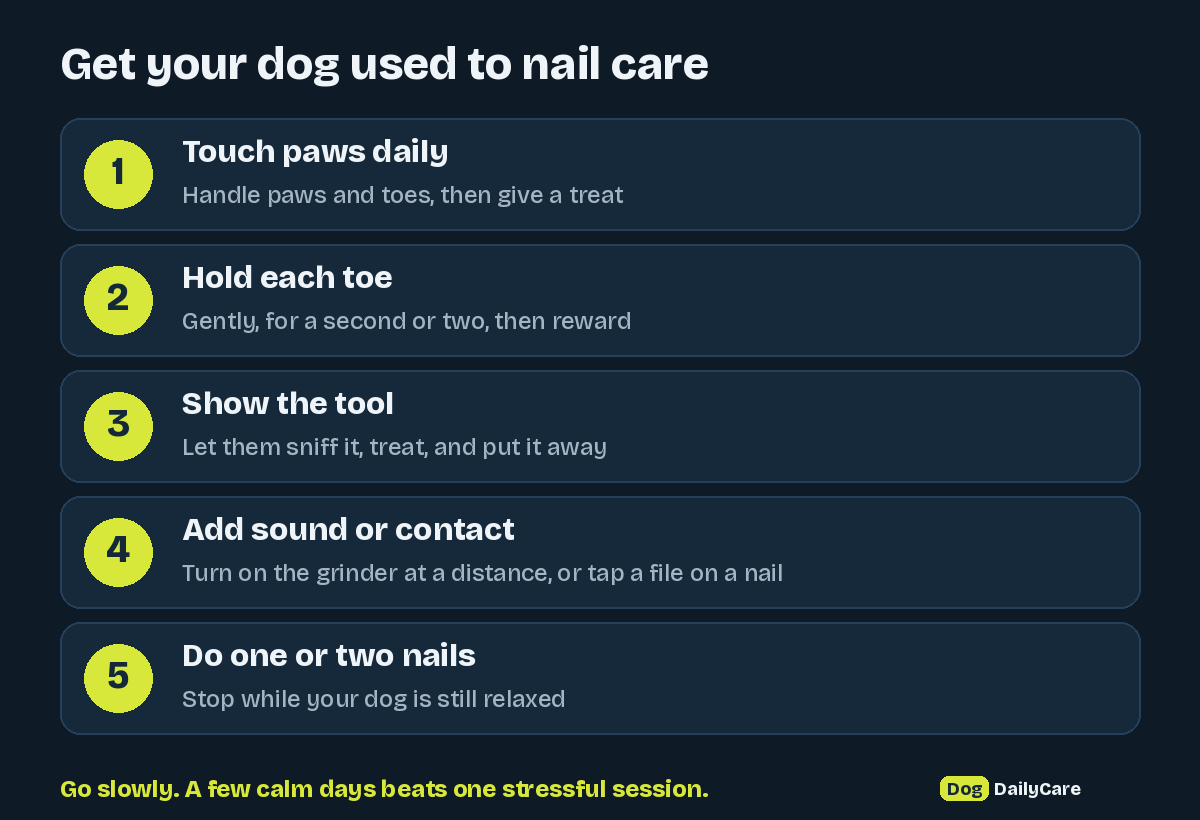
- Touch paws daily and give a treat.
- Hold each toe gently for a second or two, then reward.
- Show the tool, let your dog sniff it, then treat and put it away.
- Add sound or contact. Turn on the grinder at a distance, or tap a file on a nail.
- Do one or two nails, and stop while your dog is still relaxed.
Never shout or force your dog. A few calm sessions work better than one stressful one. The ASPCA also has advice on nail care.
What if you cut the quick?
It can happen even to experienced owners. The nail may bleed for a few minutes.
- Stay calm, so your dog stays calmer.
- Press a clean cloth or gauze on the nail.
- Apply styptic powder if you have it. In an emergency, cornstarch or flour can help.
- Bleeding usually stops within about five minutes. Call your vet if it doesn’t.
Keep styptic powder at hand whenever you trim.
How often should you trim your dog’s nails?
There is no fixed schedule. Check weekly, and trim when the nails click on hard floors or reach below the paw pad. Dogs that walk on pavement wear nails down more, but dewclaws and indoor dogs usually need regular trims. See our dog grooming guide for the full routine.
When to see a vet or groomer
Contact your vet or a professional groomer if:
- The nails are very long, curling into the pad or growing into the skin
- A nail is split, torn, bleeding or infected
- Your dog is very stressed, growls or tries to bite when you touch their paws
- Your dog limps, licks their paws or has swollen toes
- You’re not confident trimming at home
Common questions
Can I use human nail clippers on my dog?
It isn’t a good idea for adult dogs. Human clippers can crush or split dog nails, and they can hurt. Use clippers or a grinder made for dogs.
Is a nail grinder safer than clippers?
Many owners find a grinder easier to control, because you remove tiny amounts at a time. But it makes noise and can heat up the nail, so it needs patience and practice.
Can I just file my dog’s nails?
Yes, for small touch-ups and young puppies. It’s slow, so it may not be enough for fast-growing or very long nails.
Does walking on pavement trim dog nails?
It helps wear them down, but usually not enough, especially for dewclaws. Most dogs still need regular trims.
What if my dog hates having their nails done?
Go back to paw handling with treats and move more slowly. If your dog is still very stressed, ask a groomer or vet to help.
A final word
You don’t need clippers to look after your dog’s nails. A grinder, file or scratch board, a little patience and plenty of treats will do the job, and your groomer or vet is there when you need help. This guide is general information and does not replace veterinary advice.
Next, see our guides on dog grooming and how to bathe a dog without a bathtub.