
Dogs have fur, but that doesn’t mean they’re never cold. A Husky might love a snowy walk, while a Chihuahua starts shivering at the door. So how cold is too cold for dogs? There’s no single number, but there are clear guidelines. This guide gives you a simple temperature chart, the signs of cold, tips on coats and what to do in an emergency.
How cold is too cold for dogs?
Pet and vet sources give similar guidelines, and they are only a starting point. Many suggest that most dogs are comfortable above about 45°F (7°C), that care is needed below that for small, old, young or sick dogs, and that below about 20°F (-7°C) all dogs are at higher risk of hypothermia and frostbite.

- Above 45°F (7°C): comfortable for most dogs. Still watch very small, old or sick dogs.
- 32 to 45°F (0 to 7°C): take care. Small, short-coated, young, old or sick dogs may need a coat and shorter walks.
- 20 to 32°F (-7 to 0°C): limit time outside. Keep walks short, give most dogs a coat and watch for signs of cold.
- Below 20°F (-7°C): high risk for all dogs. Hypothermia and frostbite are possible, so keep outings very brief.
These numbers are guidelines, not rules. Wind, rain, damp and your dog’s health can make a mild day feel much colder. The ASPCA’s simple rule is that if it’s too cold for you, it’s probably too cold for your dog.
What affects how cold your dog feels?
- Size: small dogs lose heat faster than large ones, because they have more skin surface for their body weight.
- Coat: thick double coats, like a Husky’s, insulate well. Short, thin coats, like a Greyhound’s, and hairless breeds give little protection.
- Body fat: lean dogs get cold more easily.
- Age: puppies and senior dogs can’t regulate body temperature as well.
- Health: illness, injury and some conditions make dogs more sensitive to cold.
- Wet and wind: a wet or windy day feels colder than the temperature suggests.
- Acclimatisation: a dog that is used to cold copes better than a dog that’s mostly indoors in a warm house.
Signs your dog is too cold

- Shivering or shaking while outside
- Slowing down or stopping on walks
- Lifting paws off the cold ground
- Whining or trying to turn back for home
- Cold ears and paws, and pale gums
- Lethargy or stiffness, such as seeming sleepy, stumbling or hard to rouse
Don’t wait for these signs. If your dog shows any, end the walk and warm them up. Shivering can stop when a dog gets very cold, so a dog that is no longer shivering but seems weak isn’t necessarily warm.
Does your dog need a coat?
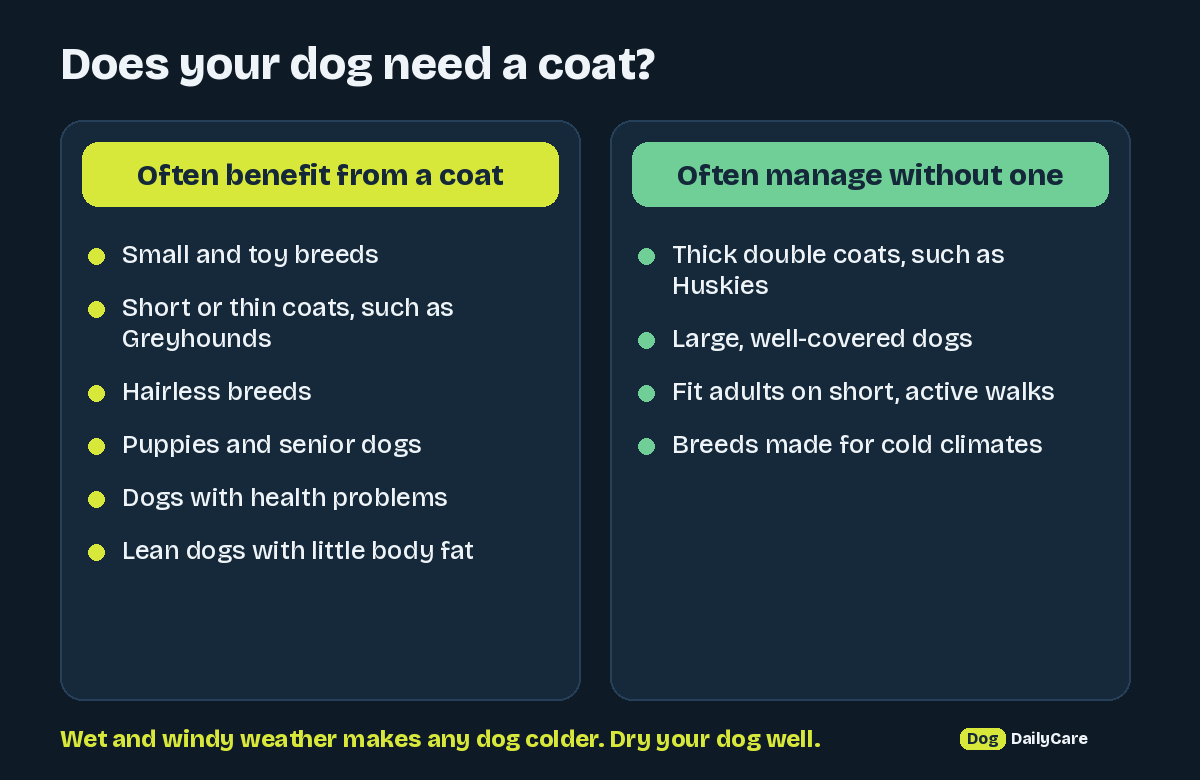
Dogs that often benefit from a coat: small and toy breeds, dogs with short or thin coats (such as Greyhounds and Whippets), hairless breeds, puppies, senior dogs, dogs with health problems, and lean dogs with little body fat.
Dogs that often manage without one: thick double-coated breeds such as Huskies, large well-covered dogs, and fit adults on short, active walks.
Choosing a coat
- It should cover the back, chest and belly, and be snug but not tight.
- Your dog should be able to walk, sniff and toilet freely.
- Choose a waterproof outer layer for rain and snow.
- Take it off indoors, and dry it if it gets wet. A wet coat makes your dog colder.
How to keep your dog warm in winter
- Shorten walks in very cold weather, and use more frequent short outings.
- Dry your dog after walks, especially paws, belly and ears. Wet fur loses heat fast.
- Protect paws with booties or balm, and wipe off salt and chemicals. See our guide on how to protect dog paws in winter.
- Give them a warm bed off the floor and away from draughts.
- Stay indoors on the coldest days, and play inside with games and puzzle toys.
- Never let your dog walk on frozen lakes or ponds, because the ice may not hold.
- Keep ID tags on, because dogs can lose the scent trail in snow and get lost.
- Take care with heaters. Keep space heaters and fires out of reach, and don’t use a heating pad on your dog unsupervised.
Outdoor dogs in winter
Dogs that live outside need a dry, draught-free shelter that’s off the ground, with plenty of bedding, and fresh, unfrozen water. In severe cold, the safest choice is to bring them indoors. The ASPCA recommends keeping pets inside when the temperature drops.
What is hypothermia in dogs?
Hypothermia happens when a dog’s body temperature drops below normal. A dog’s normal temperature is around 101 to 102.5°F (38.3 to 39.2°C), and a reading below roughly 99°F (37.2°C) can signal hypothermia that needs treatment, according to PetMD. Signs range from shivering, muscle stiffness, lethargy and pale gums to difficulty walking, collapse and a slowed heart rate.
Hypothermia isn’t only an extreme-cold problem. Wet, windy weather, illness, injury and old age can all contribute.
What to do if your dog gets too cold
- Get indoors to a dry, warm place.
- Dry your dog with a towel and wrap them in blankets.
- Warm them gradually. Warm, not hot. Wrapped warm water bottles, with several layers of fabric between the bottle and your dog, can help. Avoid heating pads and direct heat, which can burn.
- Call your vet straight away. Hypothermia can be life-threatening, so even if your dog seems better, get advice. Severe cases need emergency care.
Frostbite in dogs
Frostbite damages skin and tissue in very cold weather, usually on the paws, ears and tail. Look for pale, grey or bluish skin that feels cold and hard, and later redness, swelling or blisters (VCA Guide). Don’t rub or massage the area, and don’t use hot water. Move your dog somewhere warm and contact your vet.
When to see your vet
Contact your vet if your dog:
- Is shivering hard, weak, stumbling or very sleepy after being out in the cold
- Has pale gums, cold skin or signs of frostbite
- Has cracked, bleeding or swollen paws
- Won’t eat or drink, or seems unwell after winter weather
- May have swallowed antifreeze or de-icing chemicals
For more winter advice, see Dogs Trust.
Common questions
What temperature is too cold for dogs to be outside?
It depends on the dog. Many guides suggest that below about 45°F (7°C) small, old, young and sick dogs need extra care, and below about 20°F (-7°C) all dogs are at risk, so keep outings brief.
Is 30 degrees too cold for dogs?
At 30°F (-1°C) many dogs need a coat and a short walk. Small, short-haired and older dogs may be uncomfortable even sooner, so watch for signs.
Do dogs get cold at night?
Yes, especially in unheated rooms or outdoors. Give your dog a bed off the floor, away from draughts, with warm blankets.
Can dogs get hypothermia indoors?
It’s uncommon, but possible in a very cold home, or in a wet, small or unwell dog. Keep your dog’s bed warm and dry.
Why does my dog shiver when it’s not cold?
Dogs also shiver from excitement, nerves, pain or illness. If it’s happening often, or alongside other signs, ask your vet.
A final word
Every dog is different, so get to know yours. Watch their behaviour, keep walks short when it’s cold, dry them well and use a coat if they need one. This guide is general information and does not replace veterinary advice.
Next, see our guides on how to protect dog paws in winter and dog exercise.